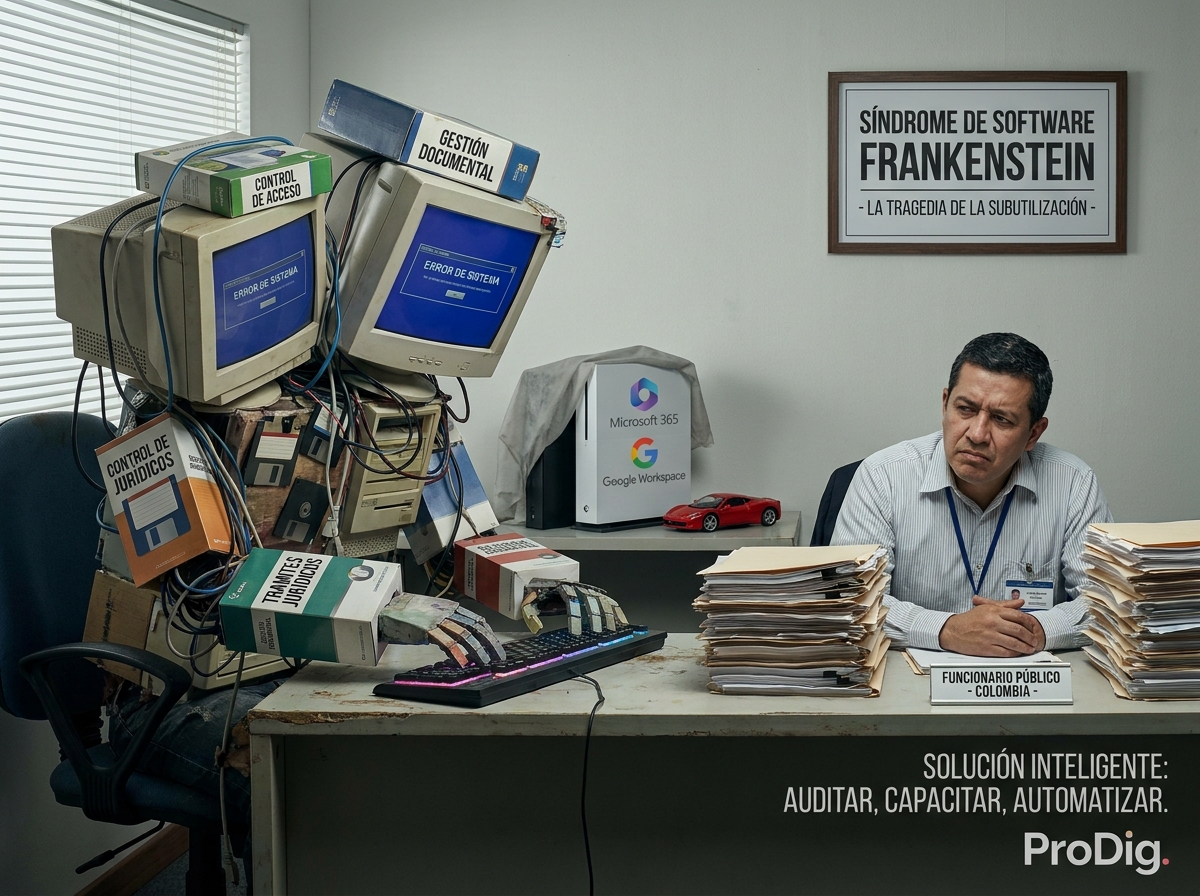
We all have that friend, family member, or acquaintance who works in a Colombian government agency. A few days ago, while talking with one of them, he told me with frustration about his daily grind. He described a reality that, far from being an exception, is the rule in public administration: entities trapped in inefficient digital bureaucracy, where gigantic budgets are burned on technology while employees remain stuck in paperwork and the "fear" of innovation.
This conversation got me thinking about the enormous disconnect between the technological capacity the State purchases and what it actually uses. It is a perfect snapshot of what I call "The Software Frankenstein Syndrome", a condition that affects not only the public sector but also hundreds of traditional companies in our country.
Below, we break down the three major symptoms of this digital disease and, most importantly, how the right mindset can cure it.
Symptom 1: The criminal underuse of super-licenses
It is common to hear that public entities lack budget. However, when you look at their daily tools, you discover they pay millions of dollars in corporate licenses for robust suites (such as Microsoft 365 or Google Workspace, among others).
They have access to workflow automation tools, document management, cloud databases, and advanced analytics. But what is the reality? Actual use does not go beyond sending emails, writing text in Word, and filling infinite Excel sheets that break all the time.
They have a Ferrari parked in the institutional garage, but they only use it to go to the corner store.
Symptom 2: The birth of "Software Frankenstein"
Because the tools they have already paid for are not being exploited, organizations fall into an expensive trap: hiring custom software for every small problem.
If a legal claim arrives, they contract external software for document management. If they need to validate employee access to facilities, they contract another piece of software. In the end, the entity ends up with a fragmented ecosystem of programs that do not talk to each other, each requiring an independent maintenance contract, and to make matters worse, they also hire an "on-site technical support team" to manually solve what the software they bought should be automating.
The absurdity is that, using the ecosystem already included in their licenses (such as Microsoft's Power Platform: Power Apps, Power Automate and SharePoint, or Google Workspace's business ecosystem), a single engineer with the right vision could unify and automate 90% of those processes in a matter of weeks, at zero new licensing cost.
Symptom 3: "Code Elitism" and the fear of change
Why don't internal technical teams do it? Here we hit two cultural barriers:
Risk aversion: In the public sector, the fear of investigations or sanctions paralyzes initiative. It is easier to hire a third party for hundreds of millions of pesos and delegate blame if something fails, than to design an efficient internal solution and assume responsibility for its success.
Traditional engineering bias: There is widespread disdain in the software development world toward Low-Code or the use of Artificial Intelligence to automate tasks. Many professionals feel that if they are not writing pure code from scratch, the work is not "respectable". They forget that the true value of a technologist is not writing code for pleasure, but solving problems as quickly, cheaply, and efficiently as possible.
The AI paradox: Laziness or Superpower?
Amid this landscape, the arrival of generative Artificial Intelligence has generated a mixed reaction. For example, a friend mentioned that in his agency, they frowned upon an employee who used AI for a task, labeling his work as "mediocre".
And they are partly right: the problem is not the tool, but how it is used. The average employee uses AI to "cut corners": they copy a generic instruction, generate plain text, and paste it without editing or verifying data. The result, logically, is cardboard-like and superficial.
But when you change your mindset and use AI analytically, the game changes. In that same conversation with my friend, we did a test exercise: we took data from two complex Excel tables that would take him hours to cross-reference and analyze. Using a standard, free AI model, we structured the correct prompts and in five minutes we managed to extract the information, clean it, organize it, and generate an impeccable data analysis.
AI is not meant to replace critical thinking; it is meant to eliminate the mechanical work that burns out professionals' brains.
What is the way forward?
Change in organizations (public or private) will not come through a senior management directive or a new 200-page process manual. It will come from within, thanks to area leaders, managers, and coordinators who get tired of inefficiency.
True digital transformation consists of:
Audit what you already have: Before buying the next shiny software a vendor sells you, review what tools you are already paying for in your current licenses.
Train in utility, not theory: Fewer lectures about "the digital age" and more practical workshops on how to automate an annoying report that takes three hours a day.
Adopt Low-Code and AI as allies: Understand that technology is here to accelerate results, not to inflate egos.
At ProDig, we firmly believe that artificial intelligence and automation are not exclusive luxuries for multinationals with infinite budgets. They are here, at the click of a button, ready to transform the management of any team that dares to leave behind the "we've always done it this way".
And in your organization? Are you driving a Ferrari, or still feeding the Frankenstein?